Fuji Chemi Trading: Chemical Supply Chain Strategy in Thailand
Fuji Chemi Trading: Chemical Supply Chain Strategy in Thailand
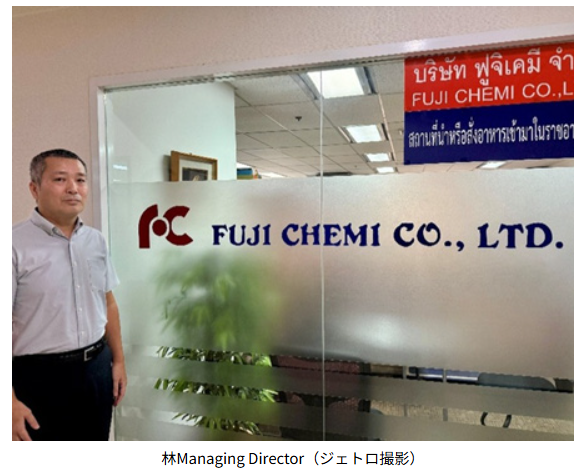
JETRO recently interviewed Mr. Hayashi Daiki, Managing Director of Fuji Chemi Thailand, on the company's business strategy and supply chain approach in the Thai market and the broader ASEAN region.
URL:タイの現場課題を解決する化学製品商社の供給網戦略(フジケミ) | ASEAN主要国の産業政策と企業によるサプライチェーン対応 - 特集 - 地域・分析レポート - 海外ビジネス情報 - ジェトロ
Fuji Chemi Trading is a specialized trading company supplying chemical products, electronic materials, and films to the automotive, electronics, and construction industries. Since entering the Thai market in 1990, the company has expanded its presence to Vietnam and China, with overseas sales now accounting for over 20% of total company revenue.
What sets Fuji Chemi apart from conventional trading companies is its unique business model that integrates trading, manufacturing, and logistics functions. The company operates its own factories for precision slitting of specialty films, and offers VMI (Vendor Managed Inventory) services to manage customers' stock on their behalf — enabling flexible responses to a wide range of customer needs.
On the competitive landscape, Mr. Hayashi acknowledges that the company faces intense price pressure from Chinese competitors, sometimes offering prices as low as one-fifth of Fuji Chemi's. Rather than engaging in a price war, the company differentiates itself by "getting close to customers' on-site challenges." The Thai sales team works closely with a technical and procurement team in Japan to propose high-specification materials and solutions only available from Japanese manufacturers, building trust that goes beyond price alone.
Looking ahead, the company is exploring a full-scale entry into the Indian market, following existing Thai customers who are expanding their operations there. Additionally, Fuji Chemi is pursuing exclusive agency positions in niche sectors such as auxiliary materials for data center HDDs, as well as venturing into BtoC lifestyle products — including masks and everyday goods — leveraging its expertise in industrial materials.
Mr. Hayashi concluded that in today's era of heightened geopolitical risk, the keys to success are "agility in decision-making" and "the ability to translate global standards into local needs" — rather than simply imposing Japanese quality standards. He emphasized that continuously addressing customers' on-site challenges and flexibly restructuring trade, logistics, and manufacturing processes is the only path to building a resilient and irreplaceable position in the supply chain.